-
The Church and the Scriptures
Read more: The Church and the ScripturesThe notion of the “Scriptures” has undergone radical changes across the centuries. Today, we picture them as a single book, the Bible. Indeed, we picture that book as private property, perhaps a personal guide for all things spiritual. Even when we hear its words being quoted in public or in Church gatherings, we imagine the readings as something bound-up in this private mode. More than that, the text of the Scriptures is frequently reduced to ideas, as propositions to be weighed and considered. All of this is largely foreign to the Scriptures in their original form. The Scriptures are “Scripture,”…
-
The Pilgrimage We Must Learn to Make
Read more: The Pilgrimage We Must Learn to MakeThere is a short comment in a letter by St. Gregory of Nyssa that has raised eyebrows for centuries on the topic of pilgrimages. Going to a holy place was big business in the Middle Ages (cf. The Canterbury Tales). Thus this epigrammatic thought of a Church Fathers, who carried the titled, “The Father of the Fathers,” troubled many: When the Lord invites the blest to their inheritance in the kingdom of heaven, He does not include a pilgrimage to Jerusalem amongst their good deeds; when He announces the Beatitudes, He does not name amongst them that sort of devotion.…
-
Bearing Shame With Christ
Read more: Bearing Shame With ChristPublic shaming is a commonplace in our culture. Public stocks and tar-and-feathering have disappeared, but shaming itself is as up-to-date as the internet itself. I well imagine that some view the use of ridicule and derision as an inherent part of public life. Those who enjoy the accolades of crowds must be prepared to endure their opprobrium. Of course, for those who live anonymous lives, such public shaming is about other people. The quiet sense (and sometimes not so quiet) that “they had it coming to them” is the strange pleasure of envy, a subset of shame. These are among…
-
The Modest Work of Salvation
Read more: The Modest Work of SalvationThere is something strangely quiet about the work of salvation. I can think of few things quieter than the exchange between the Archangel Gabriel and the Virgin Mary. The entire cosmos was undergoing a radical transformation (God becoming man) while the entire interchange might have been whispered. No one noticed that anything was going on. By the same token, the most essential act of salvation on a day-to-day or week-to-week basis is found in the act of eating and drinking – the reception of the Eucharist. It is an act so simple that, in Orthodoxy, even an infant shares in…
-
Riding the Tsunami of History
Read more: Riding the Tsunami of HistoryThere are periods of history that fascinate me, particularly if their events can be felt in our present world. My method of study is to read multiple works with a focus on detailed accounts and only a minor amount of analysis. The past couple of years, my attention has been drawn to periods of plagues and pandemics (surprise). It is undoubtedly the case that these have been turning points in human history. The plague of Justinian (541-549 A.D.) was a key factor in the rise of Islam a century later. The Black Death (mid-1300’s) changed the face of Europe and,…
-
The Ladder of Your Daily Life
Read more: The Ladder of Your Daily LifePerhaps the most prominent ladder in our culture is the one associated with careers. It is an image of the American road to success. We begin at or near the bottom and, step by step, make our way towards the top. It is a metaphor that works well with our modern notions of hard work, persistence and reward. It also serves as a justification for many of the structures in our society and colors our common view of those who linger around the bottom. It is through this cultural image that the Ladder of St. John of Sinai (Climacus) comes…
-
Hopko on the Cross of Christ
Read more: Hopko on the Cross of ChristAn excerpt from a commencement address at St. Vladimir’s Seminary in 2007, given by Fr. Thomas Hopko. It is deeply worthy of conversation. I first posted this back in June, 2007, when it was “new.” That which is true is always new and timeless. …I can tell you that being loved by God, and loving Him in return, is the greatest joy given to creatures, and that without it there is no real and lasting happiness for humanity. And I can also tell you, alas, that such loving is always a violent, brutal and bloody affair. The God who is…
-
Freedom and the Self
Read more: Freedom and the SelfThis past Sunday on the Orthodox Church commemorated St. Gregory Palamas – perhaps the most significant theologian and teacher of the late Byzantine period. He is particularly important when considering the nature of the Christian experience of God. Orthodoxy believes that it is truly possible to know God though He remains unknowable. The mystery of this true knowledge constitutes the heart of St. Gregory’s work. I offer this small reflection on the topic of freedom in his honor. Part of the experience of being involved in religious activities (like the Jesus Movement) in the late 60’s and early 70’s was…
-
St. Patrick’s Protection Against Secularism
Read more: St. Patrick’s Protection Against SecularismThe nature of secularism is the notion that anything at all exists apart from God – that is – that it has an independent existence. This is the very heart of modernity’s self-understanding: the world and all that is in it is self-existing and does not require God for its existence or well-being. This is a radical notion and is inherently atheistic. That someone might believe in God is not necessarily forbidden, but such a belief is purely a matter of individual preference and has nothing to do with the world as it actually is. Some describe modern secularism as…
Subscribe to blog via email
Support the work
Your generous support for Glory to God for All Things will help maintain and expand the work of Fr. Stephen. This ministry continues to grow and your help is important. Thank you for your prayers and encouragement!
Latest Comments
Father, I have a little bit of time. I have been reading and appreciating your articles. This made me think…
Dee, I do know that Orthodoxy holds that the soul/body are coterminous – both come into existence at the moment…
Thank you Father! I suspect but do not know that some of the explanations I’ve read or heard are probably…
Joanie, Reading primary sources is, no doubt, a good thing. Frankly, I find that our present state of education is…


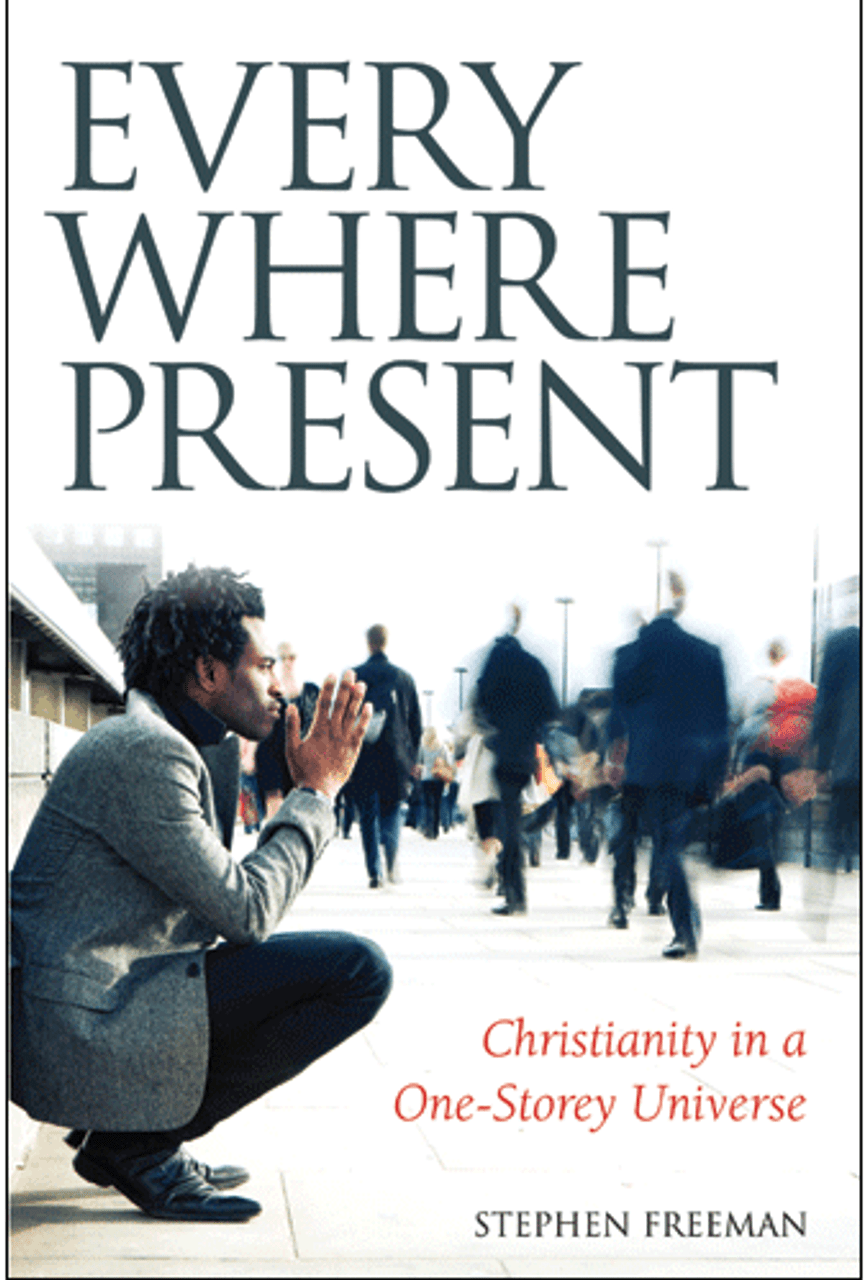
Read my books

Listen to my podcast
Please Read
Categories
Archives
Jenny, Thank you for this sharing. The “tyranny” of various false prophets is truly tragic. In Orthodoxy, we generally describe…