
-
To Sing Like a River
Read more: To Sing Like a RiverArticle from October, 2016 We stood looking out at a river rushing past the rocks – a brisk morning in the North Carolina mountains, a rare setting for the Divine Liturgy. The tradition of the Church generally holds that services such as the Divine Liturgy are to be held indoors, in the Church. There are exceptions. In monasteries across the world, it is not unusual for a major feast to be held outdoors to accommodate the large crowds that attend. But such events are exceptional. Last Sunday morning was an exception – the occasion being a liturgy for a large…
-
The Abbreviated God
Read more: The Abbreviated GodWhen an Orthodox Christian is asked questions about the faith, there is often a hesitation. The questions that come to mind (for me) are: “Where do I begin?” and “How much do I try and tell them?” For, in many ways, the amount of information includes about 2,000 years of history and an encyclopedia’s worth of teaching, practice and customs. Sometimes, in the middle of such a conversation, the other person’s eyes become dull and a rebuke comes: “I think the Bible is enough.” The drive to simplicity has long been a temptation, and, sadly, has been the source of…
-
The Secret Life
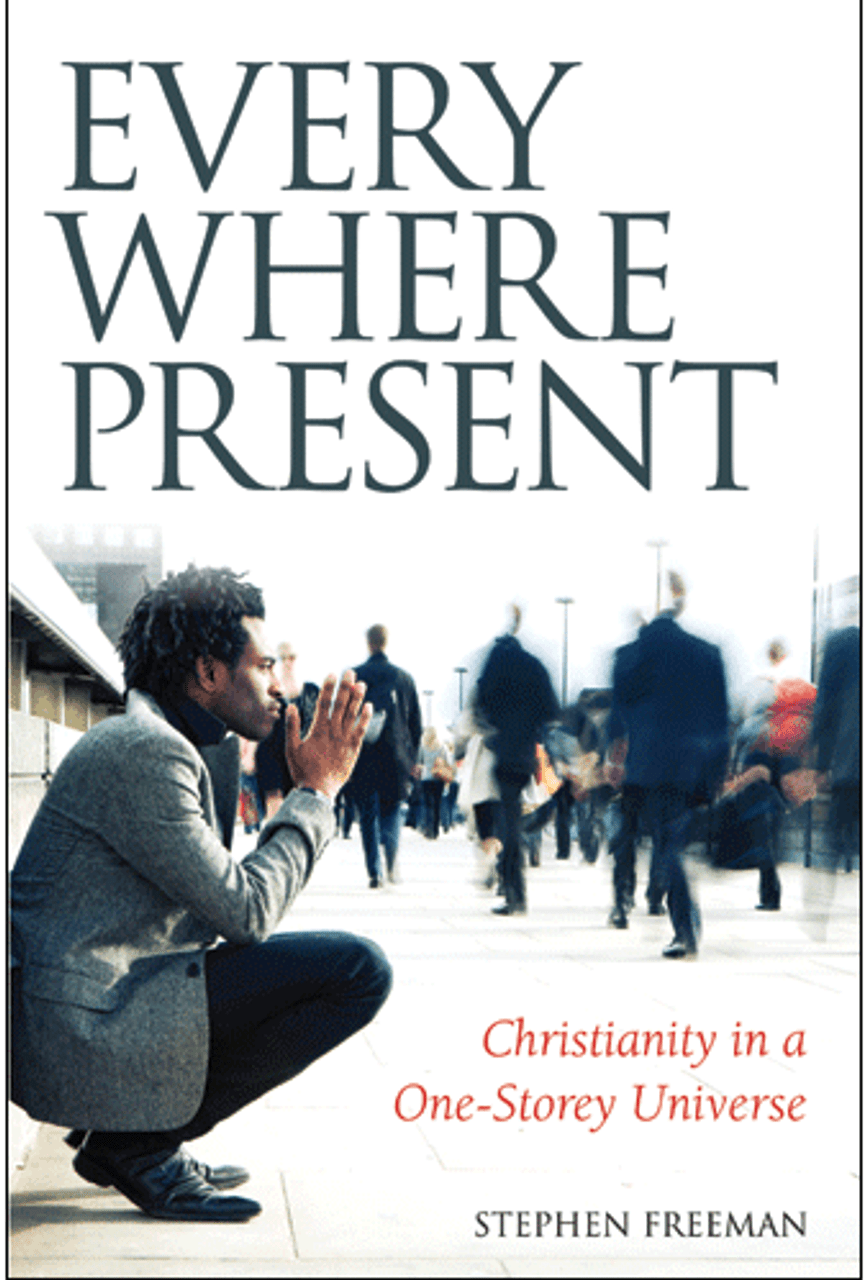
Read more: The Secret LifeThe truth of a person is always more than the person himself knows and always more than anyone else knows. Created in the image of God, human beings have an inherent transcendence. The soul is a mystery. Everywhere Present: Christianity in a One-Storey Universe What is a soul? This is the sort of question that priests dread (particularly on the lips of children). There is nothing to point to, nothing to show as an answer to the question. To believe we even have souls is an act of faith. For myself, to speak of a soul is to confess a…
-
“That Which Is Lacking” – Is Jesus Enough?
Read more: “That Which Is Lacking” – Is Jesus Enough?Recent questions on the blog make this article worth re-visiting. I pray you find it of interest. The average Christian, reading his Bible in happy devotion, stumbles across this passage: Now I rejoice in my sufferings for your sake, and in my flesh I am filling up what is lacking in Christ’s afflictions for the sake of his body, that is, the church… (Col 1:24) The passage is particularly disturbing for a certain strain of Protestant thought that emphasizes Christ’s sufficiency for all things. Christ has accomplished all things necessary to our salvation and we are thus able to “rest”…
-
The Ascetic Imperative – A Matter of Communion
Read more: The Ascetic Imperative – A Matter of CommunionAmong the more interesting experiences in my life was the two years spent in a Christian commune. It was not West Coast fancy, much less connected to anything historic such as the Bruderhof. It started with two very zealous Jesus freaks (myself and a friend), an apartment, and something of a necessity thrust on us by accident. The accident was a housefire where two other young Christian friends were living. The fire claimed the life of one and left the other injured as he jumped from a window to survive. We took him in (first, as something like a border).…
-
Becoming Personal
Read more: Becoming Personal“Person” is among the most difficult words in the classical Christian vocabulary. It is difficult on the one hand because the word has a common meaning in modern parlance that is not the same meaning as its classical one. And it is difficult on the other hand even when all of its later meanings and associations are stripped away – because what it seeks to express is simply a very difficult concept. Most of what the world understands as “person” is either a description of the “ego” or of a legal concept. But Person (I will capitalize it for use in…
-
Marriage as a Lifetime of Suffering
Read more: Marriage as a Lifetime of SufferingThis article first appeared in 2015. I have thought it worth re-publishing in honor of mine and my wife’s celebration of 50 years of marriage, joined this past weekend by my children and grandchildren and a host of friends. The service (a molieben with additional prayers appropriate to the occasion) had many of the prayers from the wedding service, with changes as needed. It’s very different to look at marriage from the vantage point of 50 years versus the wedding day of youth. My beloved wife lovingly tolerates my description of marriage as a “lifetime of suffering.” The priest who…
-
The Nature of Being Human
Read more: The Nature of Being Human“Human nature” is a term that can have a casual meaning in any number of conversations. I recently listened to a discussion with an academic professional who made the statement that “anyone who failed to understand that human nature was evil would never understand the lessons of history.” From the perspective of Orthodox theology – he had said something profoundly untrue – and, I would argue, it skewed his reading of history. What is human nature? Human nature has a casual meaning: “what are people basically like?” But in the language of the Church, a “nature” is something quite specific…
-
The Eye of Evil and the Eye of Light
Read more: The Eye of Evil and the Eye of LightThroughout the film version of Tolkien’s Lord of the Rings, the image of the “Eye of Sauron,” a tower with a great fiery eye burning at its peak, is an abiding threat overhanging every moment of conflict, every chance encounter. It threatens to interrupt the quest to destroy the Ring of Power. It is an effective cinematic feature that reminds the viewer of what is at stake. “I, too, have seen it,” Galadriel the elf-queen whispers to Frodo. No one is immune. It is interesting that Tolkien chose an eye to express the presence of active evil in his fantasy…
-
Truth, Lies, and Icons
Read more: Truth, Lies, and IconsAs verbal beings, we live in a world of icons. We experience the world in an iconic fashion. A major difficulty for us is that we have lost the vocabulary of iconic reality. We have substituted the language of photography. The dissonance between reality and our photographic assumptions has led us to doubt both. Man is an iconographer and needs to re-learn what that means. +++ Franz Kafka famously wrote: “The Lie has become the World Order.” It was a sobering estimate (by an unbeliever) of the nature of human reality. Lying, simply not telling the truth, can seem a…
Subscribe to blog via email
Support the work
Your generous support for Glory to God for All Things will help maintain and expand the work of Fr. Stephen. This ministry continues to grow and your help is important. Thank you for your prayers and encouragement!
Latest Comments
Father, I remember so many times thinking that if only I received this or that- one more experience of this…
Simon, Good questions. When you read about these questions in the Fathers, I’m thinking particularly of Dionysius the Areopagite’s work,…
Father Stephen, If nothing is outside the divine energies and there is no existence apart from God’s sustaining work, then…
Paul, There are numerous witnesses in the Fathers that the wrath or judgment of God is itself the same Divine…


Read my books

Listen to my podcast
Please Read
Categories
Archives
Jenny, Thank you for the closing quote: To celebrate the Feast of the Transfiguration is, I think, to celebrate the…