-
When Your Ancestors Came to Church
Read more: When Your Ancestors Came to ChurchHuman beings carry within them a burden of time. We are not “fresh starts” as we come into existence. There is an inheritance that seems to carry even more than our genes. Some few years ago, I visited with my father’s oldest surviving cousin. She had known both of my parents across the years, and had known my father since childhood. In the course of our conversation she said, “Talking with you is just like talking with your mother!” I knew what she meant and blushed. My mother was the Queen of ADHD and could talk non-stop. Having gotten past…
-
The Life of the Cosmos
Read more: The Life of the CosmosThis is a reprint from 2016. I ran across it this morning and found it speaking very much of where my mind and heart have been of late. May it be of use to you. What does it mean to be alive? This is a question whose answer would seem so obvious that it is hardly worth asking. And yet. A recent comment drew attention to a different way of thinking about what is “alive.” I will offer some quotes from the comment and then some observations of my own. I give special thanks to Justin. Everything is alive. Everything.…
-
The Gratuitous Wonder of Unbounded Joy
Read more: The Gratuitous Wonder of Unbounded JoyAny number of Orthodox conversations turn around the topic of “theosis” (to become “like God”). I’m never quite sure what people have in mind when they invoke the term. Do they imagine divine power or a transfiguration in divine light? In a culture marked by success stories, it’s easy to imagine theosis as just that. Indeed, I’m told that among Mormons, their teaching of theosis imagines each of us getting our own planet. How American. The Scriptures have very little to say about becoming “like God.” However, they are not silent on the matter. There are two key passages that…
-
The Communion of Giving Thanks
Read more: The Communion of Giving ThanksWhom should I thank? The question is normally a matter of polite acknowledgement. A gift was given and received. Who gave it? Whom should I thank? It is inherently the nature of giving thanks that thanks must be given to someone. I cannot give thanks to nothing or no one. As such, the giving of thanks is an act of communion on one level or another. Fr. Alexander Schmemann, in the last sermon of his life, said, “Everyone capable of thanksgiving is capable of salvation and eternal joy.” I would expand that and say as well, that everyone capable of…
-
The Secular Mind Versus the Whole Heart
Read more: The Secular Mind Versus the Whole HeartThinking is among the most misleading things in the modern world, or, to be more precise, thinking about thinking is misleading. For a culture that puts such a great emphasis on materiality, our thinking about thought is decidedly spooky. The philosophy underlying our strangely-constructed modernity is called nominalism (of which there are many formal varieties). Its imaginary construct of the world consists of decidedly separate objects, united only by our thinking about them. There are things, and then are thoughts about things. But the thoughts have nothing to do with the things, except in our heads. The result is the strange contradiction…
-
A Faith You Can Sink Your Teeth Into
Read more: A Faith You Can Sink Your Teeth IntoIn a now-famous experiment, volunteers were fitted with inverting lenses, such that everything they saw appeared upside-down. In a few days their brains adjusted and what they saw appeared correctly. When the lenses were removed, their naked eyes now saw things inverted, though again, after a few days their vision returned to normal. We are fearfully and wonderfully made and created in such a fashion we adapt to even very strange circumstances. We were created to survive. This adaptability is both a wonderful and a dangerous gift. It allows us to survive, but it also allows us to tolerate severe…
-
To Sing Like a River
Read more: To Sing Like a RiverArticle from October, 2016 We stood looking out at a river rushing past the rocks – a brisk morning in the North Carolina mountains, a rare setting for the Divine Liturgy. The tradition of the Church generally holds that services such as the Divine Liturgy are to be held indoors, in the Church. There are exceptions. In monasteries across the world, it is not unusual for a major feast to be held outdoors to accommodate the large crowds that attend. But such events are exceptional. Last Sunday morning was an exception – the occasion being a liturgy for a large…
-
The Abbreviated God
Read more: The Abbreviated GodWhen an Orthodox Christian is asked questions about the faith, there is often a hesitation. The questions that come to mind (for me) are: “Where do I begin?” and “How much do I try and tell them?” For, in many ways, the amount of information includes about 2,000 years of history and an encyclopedia’s worth of teaching, practice and customs. Sometimes, in the middle of such a conversation, the other person’s eyes become dull and a rebuke comes: “I think the Bible is enough.” The drive to simplicity has long been a temptation, and, sadly, has been the source of…
-
The Secret Life
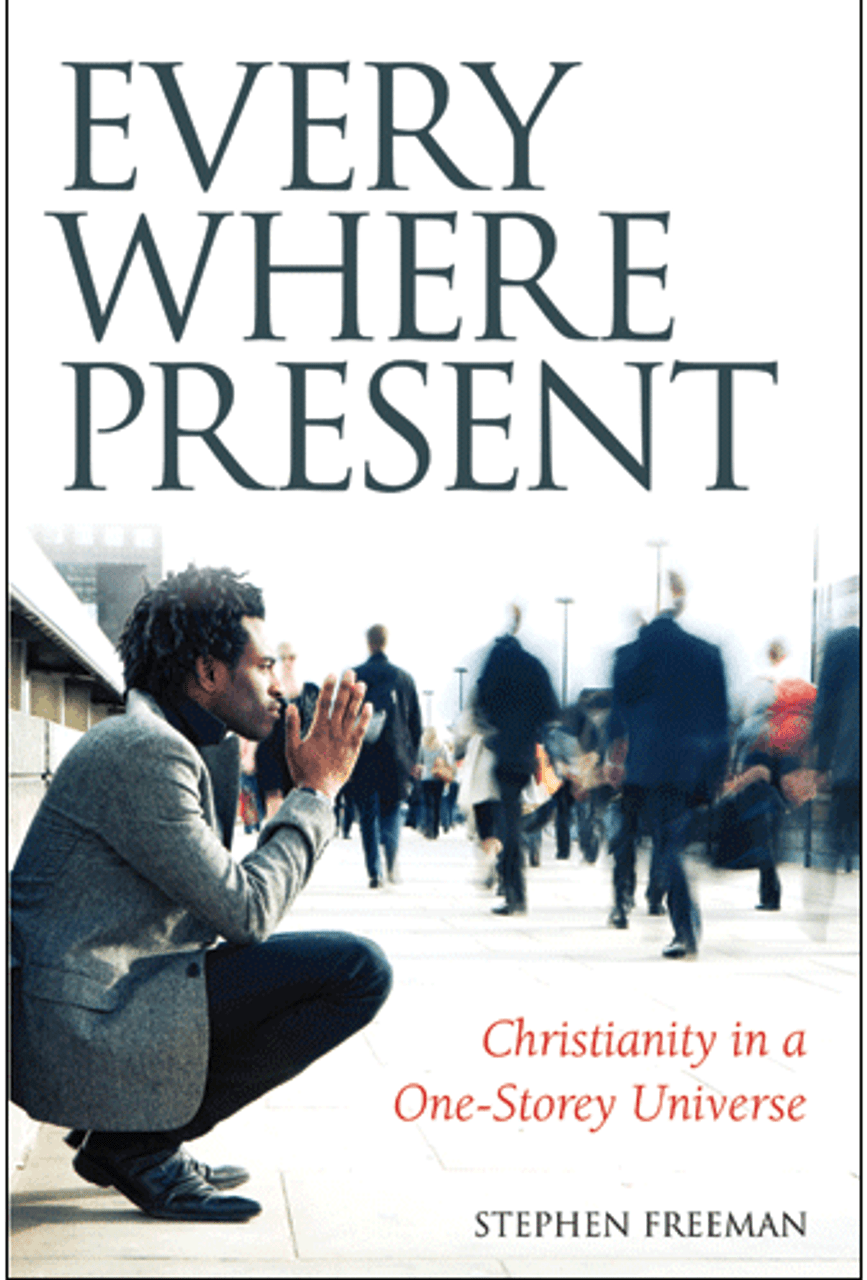
Read more: The Secret LifeThe truth of a person is always more than the person himself knows and always more than anyone else knows. Created in the image of God, human beings have an inherent transcendence. The soul is a mystery. Everywhere Present: Christianity in a One-Storey Universe What is a soul? This is the sort of question that priests dread (particularly on the lips of children). There is nothing to point to, nothing to show as an answer to the question. To believe we even have souls is an act of faith. For myself, to speak of a soul is to confess a…
-
“That Which Is Lacking” – Is Jesus Enough?
Read more: “That Which Is Lacking” – Is Jesus Enough?Recent questions on the blog make this article worth re-visiting. I pray you find it of interest. The average Christian, reading his Bible in happy devotion, stumbles across this passage: Now I rejoice in my sufferings for your sake, and in my flesh I am filling up what is lacking in Christ’s afflictions for the sake of his body, that is, the church… (Col 1:24) The passage is particularly disturbing for a certain strain of Protestant thought that emphasizes Christ’s sufficiency for all things. Christ has accomplished all things necessary to our salvation and we are thus able to “rest”…
Subscribe to blog via email
Support the work
Your generous support for Glory to God for All Things will help maintain and expand the work of Fr. Stephen. This ministry continues to grow and your help is important. Thank you for your prayers and encouragement!
Latest Comments
Colin, I grew up Baptist and became a (more or less) high church Anglican as a teenager. I began some…
Colin, She prays for us all.
How, I have no definitive answer – it’s something that the formal teaching of the Church largely passes over in…
Thank you Father. As a Protestant I feel somewhat embarrassed and diminished in my faith by my neglect of the…


Read my books

Listen to my podcast
Please Read
Categories
Archives
Thank you Father . Much appreciated and significant. At age 67 I am still learning and experiencing a deeper communion.