Search results for: “ontological”

  • Saved by the Stuff of Grace

    I can think of few phrases in modern Christian speech that have been more abused through misuse and overuse than “we are saved by grace.” As a young Protestant, this was explained to me thus: “We are saved by God’s unmerited favor.” This has the unfortunate implication that, whatever salvation may be, it’s something that’s happening in the mind of God – His unmerited favor. It strikes me as somewhat empty. Its emptiness belongs to that nefarious doctrine (as I would describe it) of the Penal Substitutionary Atonement (PSA), in which God’s justice demands our condemnation, while God’s mercy demands…

    Read more: Saved by the Stuff of Grace
    , ,
  • Love and Being

    Perhaps the most intriguing statement in the New Testament is St. John’s simple, “God is love.” As mysterious and awesome as the revelation of the Divine Name (“I am that I am”) to Moses might be, St. John’s statement gives a content that echoes and infolds the death and resurrection of Christ itself. Indeed, any other statement about God runs the risk of obscuring this essential revelation. More than that, to say, “God is love,” reveals the full character of being and existence. In our everyday thought and speech, we are accustomed to thinking about love as an action, a…

    Read more: Love and Being
    , ,
  • The Space Between

    Is there a God “out there”? God is “everywhere present and filling all things,” we say in our Orthodox prayers, but is He “out there?” For what it’s worth, I want to suggest for a moment that He is not. Largely, what I am describing is what takes place in our imagination – that is, what we picture when we pray and how we think of God as we seek Him. There are, to my mind, two primary ways of thinking and speaking about God. One is “juridical,” the other “ontological.” Juridical relationships are largely how we imagine relationships in…

    Read more: The Space Between
    ,
  • To See Him Face to Face

        “The self resides in the face.” – Psychological Theorist, Sylvan Tompkins +++ There is a thread running throughout the Scriptures that can be described as a “theology of the face.” In the Old Testament we hear a frequent refrain of “before Thy face,” and similar expressions. There are prayers beseeching God not to “hide His face.” Very clearly in Exodus, God tells Moses that “no one may see my face and live.” In the New Testament, there is a clear shift. The accounts of Christ’s transfiguration describe His face as shining. St. Paul speaks of seeing God “in…

    Read more: To See Him Face to Face
    , ,
  • The Erotic Language of Prayer

      The very heart of true prayer is desire, love. In the language of the Fathers this desire is called eros. Modern usage has corrupted the meaning of “erotic” to only mean sexual desire – but it is a profound word, without substitute in the language of the Church. I offer a quote from Dr. Timothy Patitsas of Holy Cross in Brookline: By eros we mean the love that makes us forget ourselves entirely and run towards the other without any regard for ourselves. Allan Bloom described eros as “love’s mad self-forgetting.” (from Road to Emmaus, Vol. XV, No. 2,…

    Read more: The Erotic Language of Prayer
    , ,
  • Truth, Lies, and Icons

        As verbal beings, we live in a world of icons. We experience the world in an iconic fashion. A major difficulty for us is that we have lost the vocabulary of iconic reality. We have substituted the language of photography. The dissonance between reality and our photographic assumptions has led us to doubt both. Man is an iconographer and needs to re-learn what that means. +++ Franz Kafka famously wrote: “The Lie has become the World Order.” It was a sobering estimate (by an unbeliever) of the nature of human reality. Lying, simply not telling the truth, can…

    Read more: Truth, Lies, and Icons
  • To See Him Face to Face

      “The self resides in the face.” – Psychological Theorist, Sylvan Tompkins +++ There is a thread running throughout the Scriptures that can be described as a “theology of the face.” In the Old Testament we hear a frequent refrain of “before Thy face,” and similar expressions. There are prayers beseeching God not to “hide His face.” Very clearly in Exodus, God tells Moses that “no one may see my face and live.” In the New Testament, there is a clear shift. The accounts of Christ’s transfiguration describe His face as shining. St. Paul speaks of seeing God “in the…

    Read more: To See Him Face to Face
    , , , ,
  • The End of the Sacraments – The End of All Things

    The holidays bring a bit of my family together – for fun and conversation and the joy of a feast. The conversations, however, can serve as a reminder of what I don’t know. Two of my adult children are deep into the world of computers: one is a software engineer, the other a web-designer (among other things). Sometimes their conversations lapse into the technical world of jargon – words that I do not know. I see that they’re smiling at each other so there’s no argument taking place. As a parent, all I can do is nod and pretend not…

    Read more: The End of the Sacraments – The End of All Things
    , , ,
  • The Gospel of Progress – and the New Jerusalem

    American fans of Monty Python will be familiar with the opening lines of William Blake’s poem, “Jerusalem” (and I apologize to my British readers for such an introduction). The poem was set to music in 1916 and became deeply popular in post-war Britain. The Labour Party adopted it as a theme for the election of 1946. It recalls the legend of Christ’s visit to England as a child (taken there by St. Joseph of Arimathea). Blake spins it out into a vision of the heaven to be built in the modern world: And did those feet in ancient time Walk…

    Read more: The Gospel of Progress – and the New Jerusalem
    , , ,
  • It’s a Lying Shame

    The story of the first sin begins not with a choice, but with a lie. As much as we tend to emphasize “free-will” as the origin and dominant factor of human sin, we do well to remember the true nature of our lives. Things are much more complicated than freedom can account for. Rather, we act in the context of lies and deception, some from outside and some from within. It is only the “truth” that can set us free – that is – only reality as it is constituted by God can set us in the position of making…

    Read more: It’s a Lying Shame
    , , ,

Subscribe to blog via email

Support the work

Your generous support for Glory to God for All Things will help maintain and expand the work of Fr. Stephen. This ministry continues to grow and your help is important. Thank you for your prayers and encouragement!


Latest Comments

  1. Thank you Fr. Stephen, and all for this comment section. This has given me much to think and pray about.…

  2. Fr. Stephen, Nikolas, I am thinking out loud. I have a tendency to want to place hell beyond the particulars…

  3. Nikolaos, I am not willing to say what is the case ultimately. There is enough disagreement (here and there) on…

  4. Simon Understanding that Christ is both heaven and hell, depending on how each one will perceive him in his second…


Read my books

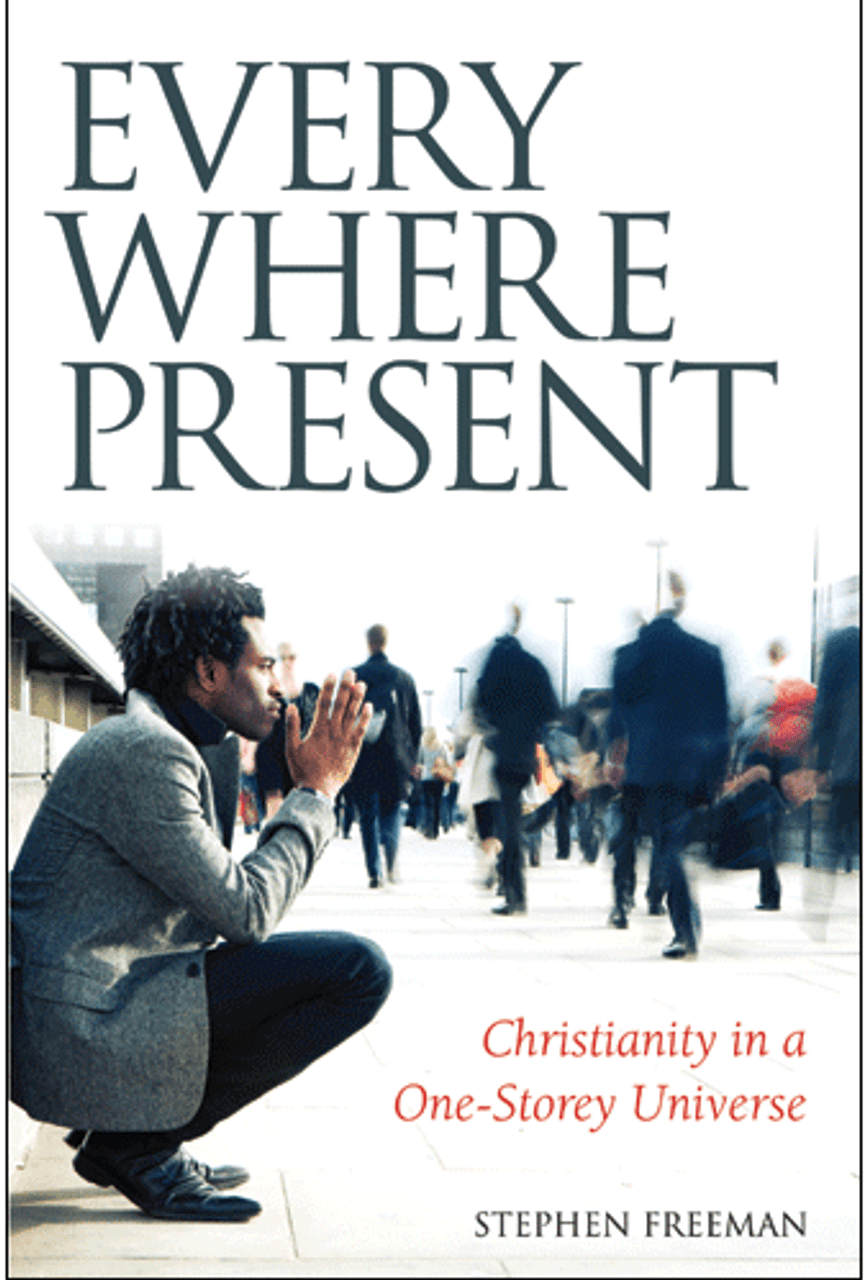
Everywhere Present by Stephen Freeman

Listen to my podcast


Categories


Archives