Screwtape and the Wisdom of a Four-Year-Old Boy

When my son was four, he wrote a prayer to St. Michael. We had placed a small statue of St. Michael on his chest-of-drawers. It was classic: St. Michael in Roman soldier’s outfit with a drawn sword, and the devil beneath his foot. It seemed to have made a strong impression on my son. His prayer:

Dear St. Michael,
Guard my room.
Don’t let anything eat me or kill me.
Kill it with your sword!
Kill it with you sword!
Amen.

I wrote about it on the blog. Years later, it became an inspiration for a children’s book that Ancient Faith published. We were honored.

In its simplicity, the prayer is charming. It’s charm, however, could prevent the reader from hearing its much deeper instinct. It is an instinct that CS Lewis displayed in the frightening character of Screwtape.

The Screwtape Letters are presented as the advice of a senior demon to one much junior, described as his “nephew.” It is book whose genius is found in its perversity – in that it requires us to think “backwards” in order to see the truth of things. What the enemy wants of us is quite the opposite of what Heaven wants of us. Quietly, though, there is a sub-theme throughout the letters of advice that reveal the true nature of evil itself. There is no true loyalty among the demons. “Uncle” Screwtape reveals over and over that, whatever may come about with their “patients” (the humans whom they tempt), he would also like to devour his nephew. His final letter is signed, “Your increasingly and ravenously affectionate uncle Screwtape.”

Demons are the ultimate consumers. In the writings of a number of Fathers, evil is described as a “parasite.” It has not substance of its own and therefore seeks to use the substance of others. We ourselves are not evil, but evil finds a place within us and seeks to make us its pawns.

In the first week of Great Lent, the Church prays the Great Canon of St. Andrew. In a certain place it reads:

Brief is my lifetime and full of pain and wickedness, but accept me in penitence and recall me to awareness of Thee. May I never be the possession or food of the enemy. O Savior, have compassion on me.

This is how evil sees us: as food. Nothing more.

This is the darkest part of our modern life, that the world is so easily reduced to a commodity. In the horrors of the 20th century (still with us in a variety of forms), human beings were consigned to various forms of extermination, but, in every case, with an accompanying effort at their de-humanization in the process.

Among the stories we know from those times are some that reveal a degree of humanity that we describe as sainthood. Some calmly took the place of others who were being led to the death chambers. Their voluntary and innocent self-offering crushed the lies of those who sought to turn human beings into commodities.

“Do not let anything eat me or kill me.”

When we reduce the world to the level of commodity, some thing to be consumed, we discover that we cannot at the same time shield ourselves from that terrible reckoning. We ourselves become the objects of consumption.

“His tail drew a third of the stars of heaven and threw them to the earth. And the dragon stood before the woman who was ready to give birth, to devour her Child as soon as it was born.” (Rev 12:4)

It would seem clear that anything less than love tends towards the commodification of other human beings. Our love of statistics, in which the infinite worth of each individual human being is swallowed by the aggregate of percentages, serves to blind us to the consequences of such thought. It is hard to love 23.2 percent of the population (or any other such measure). Our rush towards profits allows us to excuse and ignore the reality of our actions.

“For all the law is fulfilled in one word, even in this: “You shall love your neighbor as yourself.” But if you bite and devour one another, beware lest you be consumed by one another!” (Gal. 5:14–15 )

It is obvious that we need to eat.

“And God said, “See, I have given you every herb that yields seed which is on the face of all the earth, and every tree whose fruit yields seed; to you it shall be for food.” (Gen.1:29)

There is creation given to us as food – but not as commodity. It is the modern heresy of a secularized, monetized world that reduces food to commodity. It is little wonder that our age has seen the development of foods that are unsafe and unhealthy. They are cheap (a word that reveals its commodification) and they are sweet (serving our pleasure and not our health).

“Why do you spend money for what is not bread, And your wages for what does not satisfy? Listen carefully to Me, and eat what is good,” (Is. 55:2)

“Eat what is good.” How do we go about such eating? It is not for nothing that the most central, repeated sacrament of the Church is given in an act of eating and drinking. To eat the Body of Christ and to drink His Blood is also a lesson in eating that which is good, truly Good. It is a lesson that points us towards the proper relationship with everything we eat. As the priest breaks the Bread of the Eucharist, he says quietly:

“Divided and distributed is the Lamb of God: who is divided, yet not disunited; who is ever eaten, yet never consumed; but sanctifying those who partake thereof.”

We eat without “consuming.” The Body of Christ is not commodified. It is not reduced to an object to be disunited and consumed. Parts of creation are given to us for “food” but not for our consumption. Creation itself is given to us as a Eucharistic gift. It is to be eaten in the manner which the Eucharist itself teaches us.

The purpose of eating and drinking in the Eucharist is communion with God. The same is true for the whole of our life. Learning to eat in communion with God, indeed, learning to live in communion with God, is to live free of the commodification of the world around us.

In the 8th century B.C., God spoke to Israel through the prophet Amos. It is a word that continues to echo:

“Hear this, you who swallow up the needy,
And make the poor of the land fail,
Saying: “When will the New Moon be past,
That we may sell grain?
And the Sabbath,
That we may trade wheat?
Making the ephah small and the shekel large,
Falsifying the scales by deceit,
That we may buy the poor for silver,
And the needy for a pair of sandals—
Even sell the bad wheat?”

The LORD has sworn by the pride of Jacob:
“Surely I will never forget any of their works.
Shall the land not tremble for this,
And everyone mourn who dwells in it?
All of it shall swell like the River,
Heave and subside
Like the River of Egypt.
“And it shall come to pass in that day,” says the Lord GOD,
“That I will make the sun go down at noon,
And I will darken the earth in broad daylight;
I will turn your feasts into mourning,
And all your songs into lamentation;
I will bring sackcloth on every waist,
And baldness on every head;
I will make it like mourning for an only son,
And its end like a bitter day.

“Behold, the days are coming,” says the Lord GOD,
“That I will send a famine on the land,
Not a famine of bread,
Nor a thirst for water,
But of hearing the words of the LORD.” (Amos 8:4–11)

Even a little child can understand that eating one another is wrong. In wisdom, we can begin to learn how to eat in the right way – to eat that which is good – in the good way.

O Lord, how manifold are your works! In wisdom You have made them all!

About Fr. Stephen Freeman

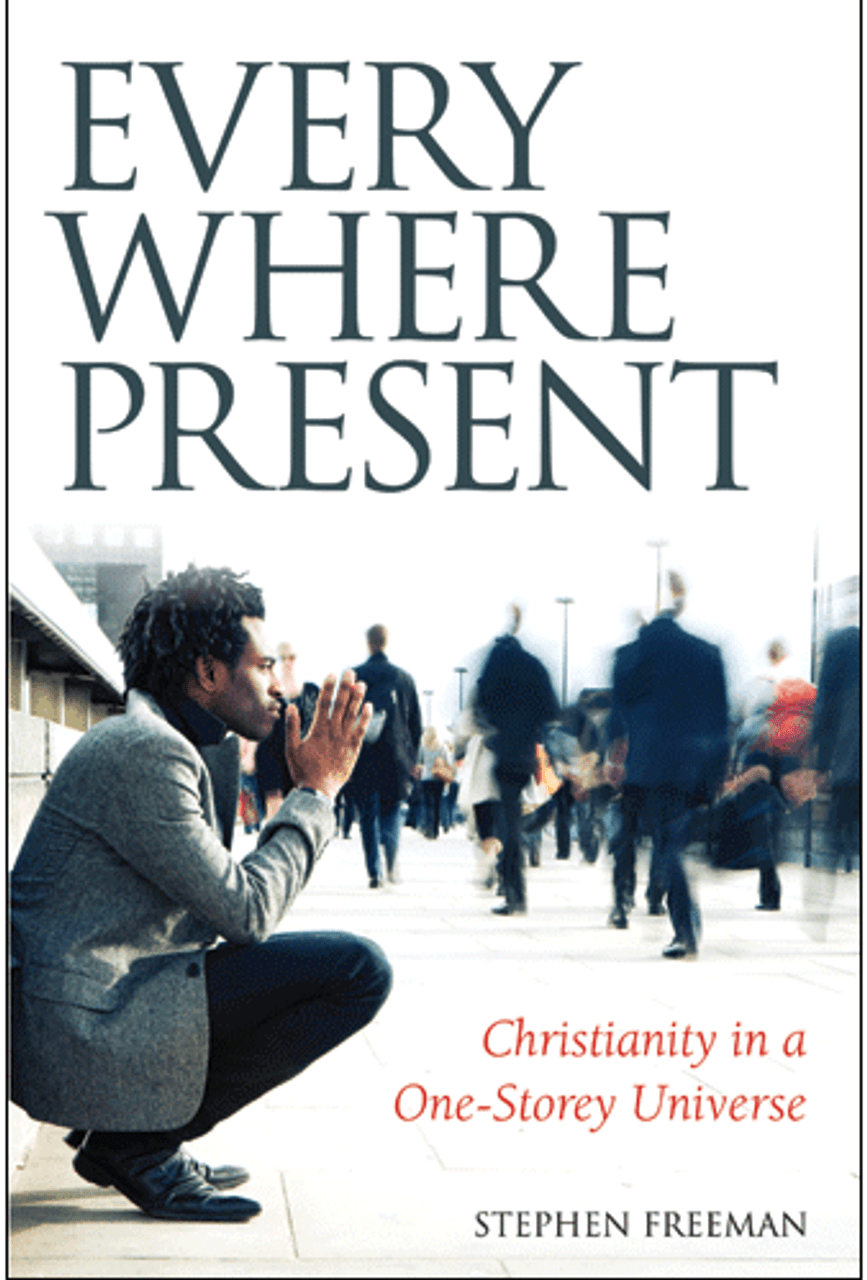
Fr. Stephen is a retired Archpriest of the Orthodox Church in America. He is also author of Everywhere Present: Christianity in a One-Storey Universe, and Face to Face: Knowing God Beyond Our Shame, as well as the Glory to God podcast series on Ancient Faith Radio.


Posted

in

, , ,

by

Comments

11 responses to “Screwtape and the Wisdom of a Four-Year-Old Boy”

  1. Dee of Sts Herman and Olga Avatar
    Dee of Sts Herman and Olga

    Father,
    This is an important message and lesson I dearly need to learn. God help us all.

  2. Brenda Avatar
    Brenda

    Dear Father,

    Thank you for this wonderful post. I have been following your blog for the past few months and it is always a joy to me whenever I am notified of a new post. I am so grateful to have found this site.

    Today’s topic of eating feels especially relevant to my life at this moment, as I have been struggling with misophonia for most of my life and the guilt and shame have been hitting me unusually hard in recent days. Loud chewing sounds cause me to feel extreme anger and it grieves me that a communal meal, which I always wish to experience as a peaceful and loving activity enjoyed by everyone who is present, is something that I have to endure due to extreme discomfort. I feel horrible for feeling angry towards someone who is not doing anything wrong and although I try to pray internally as I eat in order not to indulge in angry thoughts, the anger is just so loud inside of me.

    Do you have any advice for me on this aspect of spiritual warfare? I so wish that I could participate in dinner conversations and be joyfully present at a table without reaching for earplugs.

    Thank you and God bless you.

  3. Fr. Stephen Avatar

    Brenda,
    My experience with brain disorders is that what can’t be fixed must be accommodated in some manner. First, it’s not your fault. No doubt, such a disorder can be shame-inducing, particularly in that it cannot easily be hid. But wearing earplugs, or headphones certainly makes it possible to be at the table. The conversations can be had elsewhere. Having a supportive therapist or doctor is a good idea.

    I have a difficulty with loud noises when I first wake up. So, when my grandsons are with us (which has joyously been frequent this year), I often wear headphones as I have my coffee and slowly wake up. Eventually, I join the world, take them off, and “let the games begin.” But supportive people who know what’s going on are helpful. My grandsons have their own issues and, they learn, so does grandpa. It’s our world.

  4. Kate Avatar
    Kate

    Father Stephen, how can I learn to live in this consumeristic culture without being a consumer myself? It’s so much a part of me that I don’t know how to break free.

  5. Fr. Stephen Avatar

    Kate,
    We never truly learn anything quickly. Trying “not to do something” when stuck inside an addiction is extremely difficult(and make no mistake, the consumerism of our culture is experienced as an addiction by our brains). This means that changing a behavior is best achieved by doing something positive – by working to experience life as communion, rather than consumption.

    The Church’s life is actually geared towards this. The discipline of fasting – when taken in its most complete form – is something of an antidote to our consumerism. It teaches us to eat differently, to couple eating with prayer, to couple eating and prayer with almsgiving and repentance (confession). It’s powerful, even if it’s slow.

    Second, don’t let the devil torment you. Take up the Church’s life (Great Lent’s not far away, but use the Wednesday/Friday fasts outside of that as well) and commit yourself to work at that. Then don’t beat yourself up when you find yourself falling into a consumerist approach. Guilt and shame rarely produce anything good.

    Lastly, practice the giving of thanks. If you are going to buy something, make it a point of communion with God. Give thanks for it. Take it into your conversation of prayer. On the one hand, you might change your mind about buying it (which is fine), or you begin to change the dynamic of buying itself. By giving thanks, you make it an act of communion (on some level). Try it. Also, never forget the importance of almsgiving – giving money to the poor. I give to the local foodbank in our city, for example.

    “Rejoice always,pray without ceasing,in everything give thanks; for this is the will of God in Christ Jesus for you.”
    (1 Thessalonians 5:16–18)

    May God give us grace!

    Also, in every battle, remember that when all is said and done, we will win. Christ tramples down death by death!

  6. Margaret Avatar
    Margaret

    My thanks and gratitude to Brenda and Kate for their questions and comments here and for your love and insight in responding, Fr. Stephen. So many times I have read your blog posts over the years and Our Lord has shown Himself to me to be truly the Lover of Mankind because you address topics in a loving Christian manner that I did not know I needed to read about, much less that they will become a part of my own healing which Our Lord is overseeing and enacting in me daily. Today in reading this blog post and these comments I have this experience once again, thank you!
    Glory to God for all Things!

  7. Fr. Stephen Avatar

    Margaret,
    Thank you! His mercy endures forever!

  8. Jenny Avatar
    Jenny

    Father,

    I have been reading along and grateful for your light- even if it may be that of a flea on an elephant. 🙂 Only the Lord knows what it really is.

    I have been attending to my life and seen a great deal of work, so I haven’t been able to write much. But I have actually gotten to the point in taking care of my household and not my phone that I used my ancient bottle of Old English furniture polish, the one I purchased when first married. The furniture must be completely bewildered by this sort of treatment.

    The light is growing day by day and every day I give thanks for it, even when I cannot see it. Today I can see it through grey and white stripes of clouds and the sky is a high, clear blue.

    I’m trying to learn to eat only that which is good in a good way, and offer up in prayer that which is not. I’m stumbling around a great deal, but the Lord is a friend of sinners and He is good and upright and teaches sinners in His good way, so I have a lot of hope.

    Thank you for your prayers!

  9. Fr. Stephen Avatar

    Jenny,
    “…the Lord is the friend of sinners…” What a joyful hope!

  10. Brenda Avatar
    Brenda

    Thank you for your kind and helpful response, Father. I will definitely keep your words in mind.

    And Margaret, if you happen to see this as well, it was lovely to read your comment because I am often struck by the same feeling when spending time on this blog. It is such a safe place and I am thankful that we are able to learn here together.

  11. Kate Avatar
    Kate

    Thank you, Father Stephen, for your words of wisdom and guidance.
    Calling consumerism an addiction really struck me as I hadn’t thought of it that way, but it’s clear to me that I’m an addict!
    As I’m not Orthodox (yet!), “taking up the church’s life” will look different for me, and is something I need to ponder.
    As to the giving of thanks and of alms, I welcome the reminder and want to be much more intentional in those areas.
    You said, “If you are going to buy something, make it a point of communion with God. Give thanks for it. Take it into your conversation of prayer. On the one hand, you might change your mind about buying it (which is fine), or you begin to change the dynamic of buying itself. By giving thanks, you make it an act of communion (on some level).” Simple and yet profound!
    I find that I’m often given advice that is so far out of reach for me that it’s discouraging, but this is doable and very encouraging. I need to take simple steps, rather than giant leaps.
    Thanks again.

Leave a Reply

Your email address will not be published. Required fields are marked *


Subscribe to blog via email

Support the work

Your generous support for Glory to God for All Things will help maintain and expand the work of Fr. Stephen. This ministry continues to grow and your help is important. Thank you for your prayers and encouragement!


Latest Comments

  1. Thanks for that great advice, Fr Stephen. The Fathers and others writing before 1500 would surely be the best resources.…

  2. Dear Fr Stephen Thank you for another great article. This article is interestingly timed. In just over a week, I…

  3. This is the actual quote for those who are wondering, the one that is circulating on the internet and appears…


Read my books

Everywhere Present by Stephen Freeman

Listen to my podcast


Categories


Archives